Tank vs. Tankless Water Heater: Which Is Better for Your Home?
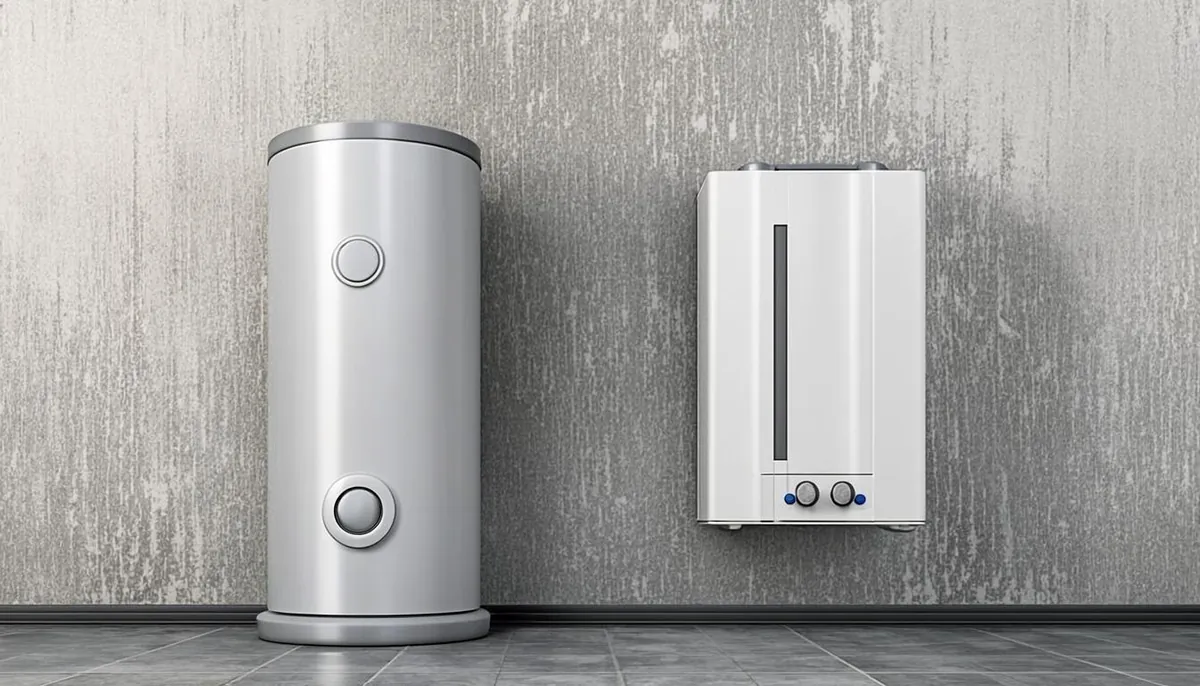
The traditional water heater vs. tankless question is the right one to ask before a replacement, and the wrong one to answer from a brochure. Both technologies heat water competently; they differ in what they ask of your house, what they cost to run, and what happens in February, which is the month that separates Maryland tankless owners into two camps. This comparison is built from our installation and service records across Anne Arundel County, and it covers the winter question most national guides skip entirely.
How Traditional Tank Water Heaters Work
A tank heater keeps 30 to 80 gallons stored hot around the clock, reheating as draws arrive and standing by in between. The architecture is simple and forgiving: one burner or element set, a thermostat, a safety valve, and a vessel whose lifespan is largely a maintenance story. The simplicity is the appeal. It is also the inefficiency: stored water loses heat continuously, so the tank cycles to hold temperature whether anyone draws or not.
How Tankless Water Heaters Work
A tankless unit heats on demand: water crosses a heat exchanger only while a fixture runs, and the burner or elements modulate to hit set temperature in real time. There is no standby loss because there is no standby. The trade is architectural: the unit must raise incoming water to shower temperature in seconds, which concentrates enormous heat into a small passage and makes the unit sensitive to everything that supports it, gas supply, venting, water chemistry, and inlet temperature.
Installation Cost Comparison
Like-for-like tank replacements are the value end of the scale, and our local ranges run from the mid $1,000s upward depending on tier and venting. Tankless installs cost more in every scenario: the equipment carries a premium, and conversions from tank add gas line uprates, new venting, and sometimes electrical work, which is why our conversion pricing opens where condensing tank pricing ends. New-construction and planned replacements soften the gap because the supporting systems are fresh. The honest framing: tankless pricing is an infrastructure project attached to a water heater.
Energy Use and Operating Costs
The tankless vs. storage water heater comparison starts here: tankless units eliminate standby loss, which is real money on households with light, scattered usage; certified gas tankless models earn their efficiency label precisely by heating only on demand. Tanks surrender some energy to standby cycling, though modern insulated tanks narrow that gap every generation. Hybrid heat pump tanks deserve their own sentence here: they move heat rather than make it, and reach efficiencies neither combustion technology matches, at the cost of equipment price and installation headroom. Fuel prices tilt the math monthly, so we run the comparison against current local rates on the estimate rather than publishing a number that ages badly.
Hot Water Capacity and Simultaneous Demand
This is where the technologies philosophically diverge. A tank is a reservoir: it absorbs a morning's stacked demand until the reserve empties, then asks for patience while it recovers. Tankless is a flow machine: it never empties, but it caps simultaneous output, and the cap tightens as inlet water cools. A tankless unit that cruised through June's two-shower mornings can struggle through the same routine in January, which is why our sizing method uses the coldest inlet of the year, not the annual average. Households with genuinely stacked morning demand fit a tank, or fit a properly winter-sized tankless with the gas supply to feed it.
Maintenance Requirements
Tanks want an annual flush, an anode inspection, and a safety check; neglected tanks age visibly and we see the results weekly. Tankless units in our region's hard water want a disciplined descaling schedule, inlet filter attention, and vent inspection; a maintained heat exchanger reaches old age that tanks envy, and a neglected one fails young. Neither technology is maintenance-free, and the maintenance types differ enough that preference legitimately decides for some households. Our maintenance service covers both rhythms.
Installation Space
Tankless wins the space argument on every utility room floor plan: a wall-hung unit frees the footprint a tank occupied and mounts where the supporting systems can reach. The catch is vertical reality: the venting route, the gas line run, and the condensate path all consume wall and ceiling space of their own. Tanks need their floor footprint, clearances, and a drain pan, and they fit attic platforms and tight closets that a tankless venting route may not. Measure both before assuming either fits.
Comfort factors live in this section too, and they are more persuasive in person than on paper. A tankless unit's fan and ignition run audibly during draws, while a tank's burner cycles are occasional and low. Condensing tankless units drip condensate that needs a path to a drain, which constrains placement more than homeowners expect. And a tankless unit mounted far from the busiest bathroom adds a few seconds of pipe-cooled water to every draw, which no efficiency number compensates for at the tap. Placement, decided with a technician who runs these systems daily, is worth as much to daily satisfaction as the equipment choice itself.
Which System Is Right for Different Households?
- Long, back-to-back showers, home spa habits, or a teenager with unlimited hot water ambition: tankless, sized to the winter inlet, earns its cost daily.
- Light usage, one or two occupants, scattered draws: tankless efficiency pays, and the compact footprint is a bonus.
- Stacked morning routines in a full house: a properly sized tank absorbs the peak that a marginal tankless cannot.
- Budget-first replacement with a healthy utility space: like-for-like tank remains the value play.
- Maximum efficiency with tank-like installation simplicity: the hybrid heat pump tank, where headroom allows.
- Planning to stay two decades: maintained tankless longevity compounds, and the conversion economics mature with it.
Our tankless installation service and our tank-side installation page both quote flat after a site check, because the house, not the brochure, decides the answer. For the conversion path specifically, our tank-to-tankless guide covers the supporting-system requirements line by line.
Do tankless water heaters work well in cold Maryland winters?
Yes, when sized and supplied for it. The unit heats colder inlet water by working harder, which reduces its maximum flow, so a winter-ready installation is one sized against the coldest expected inlet with the gas line to match. Undersized conversions are the ones that struggle each January, and that is a sizing failure, not a technology failure.
Is tankless really more efficient than a tank water heater?
In usage patterns with light, scattered draws, yes, because standby loss disappears. In households that run heavy simultaneous demand daily, the efficiency edge narrows, and hybrid heat pump tanks outperform both combustion options. The pattern of usage, not the brochure number, decides whose bill sees the difference.
Which lasts longer, tankless or tank?
Maintained tankless systems outlast tanks in our service records, with heat exchangers reaching well past the age at which most tanks are replaced. The qualifier does the work: descaling discipline is what buys those years, and neglected units fail early enough to erase the advantage entirely.
Can I install a tankless water heater myself?
We recommend against it here, and not for self-interested reasons: gas sizing, venting clearances, condensate management, and county permitting all carry code obligations, and Anne Arundel County requires the work to be performed by licensed tradesmen. A mis-sized gas line or venting shortcut on a tankless unit is expensive to discover and dangerous to ignore.
So, is a tankless water heater worth it?
For long showers, low to moderate demand, and households planning to stay put, yes: the efficiency, the unlimited delivery, and the lifespan compound year after year. For tight budgets, stacked simultaneous demand without the gas supply to feed a large unit, or short tenures, a properly sized tank or a hybrid serves better. Worth is a fit question, and the free site check is how we answer it.