How to Protect a Tankless Water Heater From Freezing During Maryland Winters
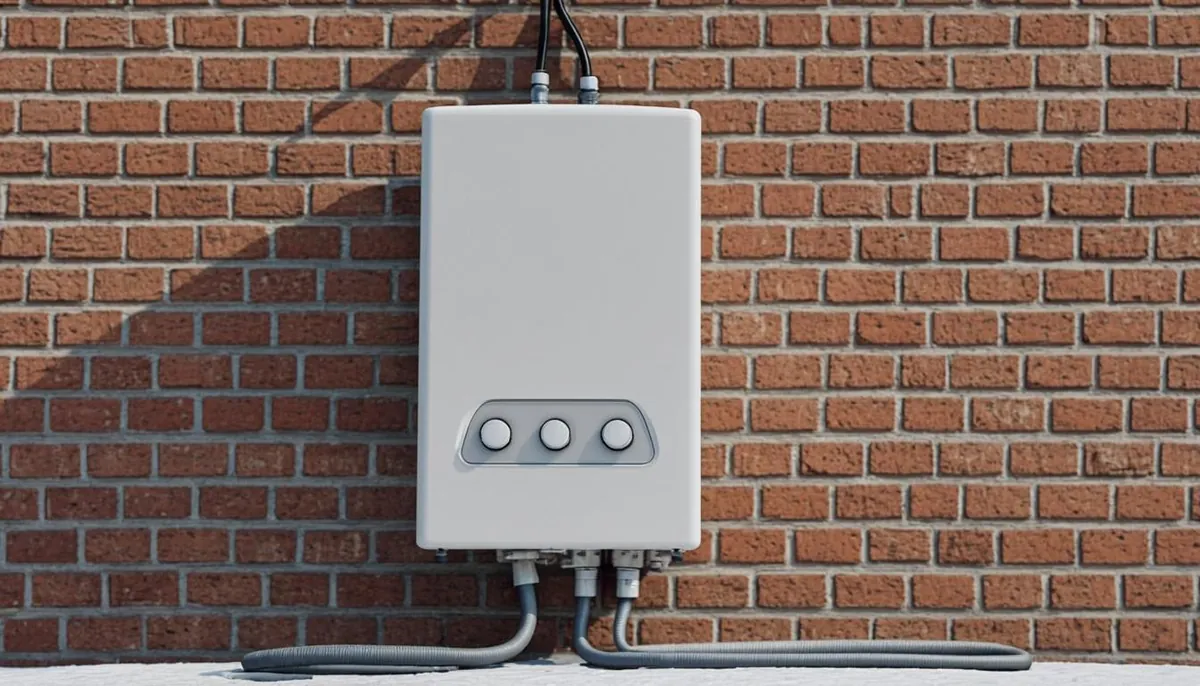
Maryland winters are exactly the ones tankless owners ask about: cold snaps that drop overnight lows well below freezing, ice storms that take power out for days, and a week in January that makes the garage feel like outdoors. Modern tankless units carry real freeze protection built in, and the honest answer about it has a boundary worth understanding before the first hard freeze. The built-in protection heats the inside of the cabinet while the unit has power; it does not protect the pipes before and after the unit, and it stops entirely when the electricity does. This guide walks through what the feature covers, where its edges are, and the layered plan that keeps a tankless system whole through a Maryland cold snap, from installation location to drain-down procedure.
Why Tankless Water Heaters Can Freeze
The design that makes tankless units compact also makes them vulnerable: instead of dozens of stored gallons acting as thermal mass, a tankless heat exchanger holds a small volume of water in narrow metal passages, and a hard freeze can expand that water until the exchanger cracks. A cracked exchanger is the most expensive failure a tankless unit can suffer, and freeze damage commonly lands outside warranty coverage because the manuals document prevention extensively. The exposure is worst where the unit and its connections live in unconditioned space: exterior wall mounts, garages, attics, and crawlspaces all see temperatures the utility room never does. A unit inside conditioned space with piping inside the envelope is a different, much safer situation, which is why the first question we ask about freeze risk is simply where the unit lives.
Understanding Built-In Freeze Protection
Most current gas and electric tankless models include electric heating elements inside the cabinet and heat exchanger assembly that warm the unit's internals when temperatures approach freezing, controlled by sensors that switch the protection on and off. Manufacturers publish a protection floor for each model, commonly well below freezing, always conditioned on one thing: the unit having electrical power. The feature is real and it works, and it earns its keep on ordinary winter nights, in garages and on exterior walls, down to the temperature the manual states. What it does not do is equally important to state plainly: it protects the equipment inside the cabinet, not the supply pipes, the outlet lines, the isolation valves, or the vent terminations around it, and every one of those can freeze and burst on a night the unit itself survives.
How Installation Location Affects Freeze Risk
Location sorts homes into three tiers. An interior utility room, mechanical closet, or basement inside the heated envelope carries minimal risk: the unit and its piping share the house's temperature. A garage, attic, or crawlspace installation is the middle tier: the space sits outside the envelope, but wind and exposure are bounded, and insulation plus the built-in protection usually carries the unit through ordinary winters. An exterior wall mount is the top tier: the cabinet and every pipe around it face the weather directly, wind strips heat from exposed fittings, and the protection elements work harder for every degree the wind takes. None of these tiers is a prohibition; tankless units are installed on exterior walls throughout this region safely. The tier decides how much of the rest of this guide applies to your house, and it is the first thing our tankless installation service discusses when a homeowner is choosing a location.
Exterior Pipes and Water Connections
The gap in built-in protection is everything the water touches outside the cabinet, so that is where winterizing spends its effort. Supply and outlet lines in unconditioned space get pipe insulation, foam sleeves as the baseline and heat tape on runs with real exposure. Isolation valve assemblies and any exposed fittings get insulated covers rather than bare brass. Wall penetrations get sealed so cold air does not draft through the chase onto the pipes behind the unit. Low points get drain provisions where the layout allows them. One boundary belongs in bold: the vent termination is part of the combustion system, and it never gets covered, stuffed, or wrapped; the water pipes get winterized, the vent gets kept clear, and the two rules are not negotiable in either direction.
Power Outages and Freeze Protection Limitations
This is the section that changes plans, because the built-in protection is electric. When a storm takes the power out, the protection elements stop, regardless of fuel type: on a gas tankless unit, the freeze protection runs on household electricity, not on the gas line, so a gas unit with no power has no more active protection than an electric one. A cabinet full of standing water in a cold garage or on an exterior wall then starts moving toward the outdoor temperature, and the hours it takes to get there depend on exposure and wind. Households with generator backup can ride outages comfortably if the generator covers the unit's draw, and that sizing question is worth answering before January rather than during the storm. For everyone else, the reliable move during a multi-day outage in an exposed location is draining the unit, which the next sections cover. What we never recommend is assuming the built-in protection rides through an outage, because the manual does not promise that, and neither do we.
Manufacturer-Specific Freeze Protection Procedures
The details that matter live in the model's manual, and they genuinely differ between manufacturers and between models from the same brand: the published protection floor, whether the condensate trap needs draining as part of a winterization, the exact sequence of valves and drain ports for a full drain-down, and any reset procedure the unit wants after a freeze event. Rinnai's documentation, like the other major brands', provides model-specific procedures and expects owners to follow them rather than improvise, and the unit's rating plate and serial number identify the exact document for the equipment on the wall. Our installations leave the manual with the homeowner and our maintenance visits label the drain points, because the middle of an outage is the wrong time to learn which valve does what. If the manual for your unit has disappeared, the manufacturer's support site reproduces it by model number.
What to Do After a Freeze Event
When a unit or its piping has frozen, the sequence matters. Power and gas to the unit stay off. A faucet is opened to give melting ice somewhere to move, and thawing happens with ambient warmth or gentle heat, never with an open flame or extreme heat applied to fittings. Before anything is repressurized, every joint, valve, and connection in the exposed run gets looked at, because ice finds the weakest fittings first and a burst connection announces itself the moment pressure returns. If the unit itself is suspected, the first firing after a freeze should happen after a professional look: a cracked exchanger does not always announce itself with a code, and pressing a damaged exchanger back into service converts a repair into a replacement. Our tankless repair service runs exactly that post-freeze inspection, and the calls we prefer to get are the ones where the drain-down happened before the storm.
Do tankless water heaters have built-in freeze protection?
Most current models do: electric elements inside the cabinet warm the unit's internals when temperatures near freezing, down to a protection floor the manufacturer publishes for each model. The protection requires electrical power to run, and it covers the equipment inside the cabinet only, never the supply pipes and connections around it.
At what temperature should I worry about my tankless unit freezing?
Worry when the space the unit lives in approaches freezing, not when the unit alone does. The manual states each model's protection floor, and unprotected nearby pipes and wall chases usually reach freezing before the cabinet does. Exterior and garage installations deserve attention from the first hard freeze of the season.
Should I drain my tankless water heater before a winter storm?
For multi-day power outage risks in exposed locations, garages, attics, exterior walls, draining per the manual's procedure is the reliable protection, because built-in protection stops when the power does. Interior units with generator backup may ride through instead. The decision follows the unit's exposure, and our fall maintenance visit labels the drain points either way.
Can a frozen tankless water heater be repaired?
It depends where the ice won. Frozen fittings, valves, and supply lines are usually straightforward repairs. A cracked heat exchanger is the serious outcome, and freeze damage commonly falls outside warranty coverage, which is why prevention gets a full guide and a fall checklist. After any freeze event, have the unit inspected before returning it to service.