What Does a Water Heater T&P Relief Valve Do?
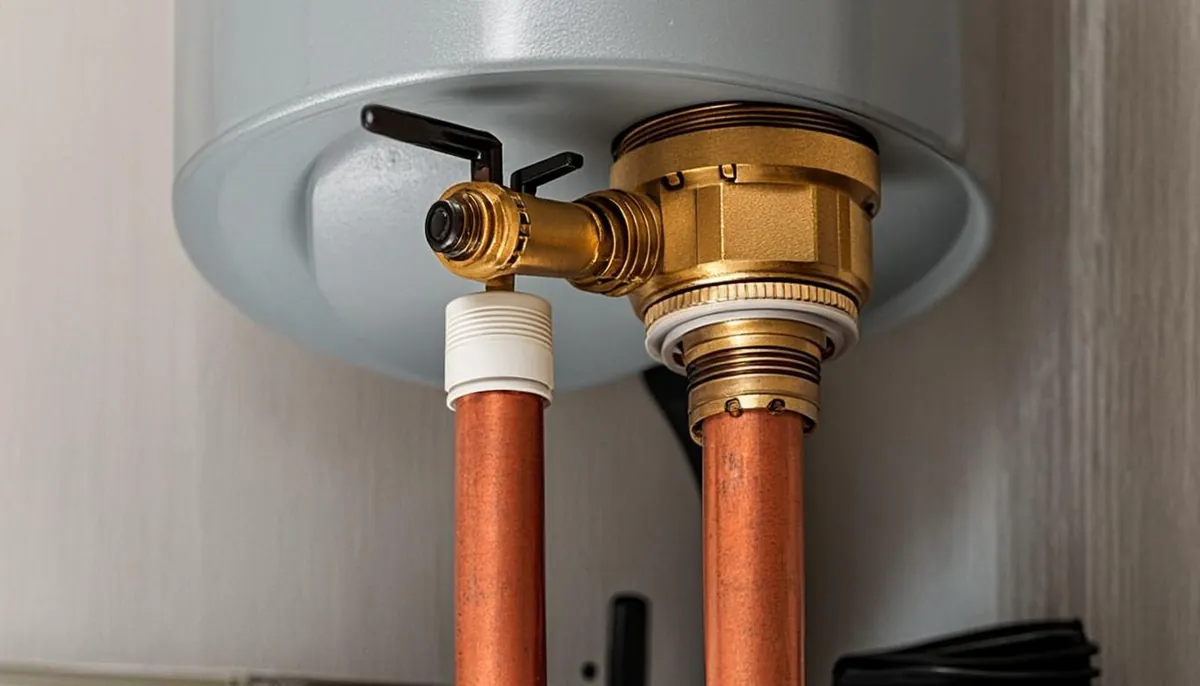
Every storage water heater carries one small brass valve whose entire purpose is preventing the worst failure in home plumbing, and almost nobody in the household can name it. The temperature and pressure relief valve, T&P for short, stands between a sealed tank of hot water and the one scenario no homeowner wants to meet: a tank that heats past its limits with no way to vent the energy. It opens rarely, it is tested less often than that, and it is the component whose discharge pipe we most often find tampered with on older installations. This guide covers what the valve does, why water sometimes runs out of its discharge pipe, how thermal expansion imitates a bad valve, and the rules around that pipe that exist for excellent reasons.
What Is a Temperature and Pressure Relief Valve?
The T&P valve is a spring-loaded safety valve installed on the tank, usually near the top, that senses two separate dangers through one seat. The pressure side opens when system pressure crosses its rating, and the temperature side opens when water at the probe reaches the threshold near the boiling point. Either condition, on its own, is enough to require action, because both describe a tank storing more energy than its design accepts. The valve is mandatory equipment on storage heaters, it is rated to the tank it protects, and it is the one component on the heater whose failure mode is measured in property damage rather than inconvenience. That combination, mandatory and catastrophic-if-ignored, is why every visit our crew makes to a tank includes looking at it.
How the T&P Valve Protects a Storage Water Heater
The protection makes sense when the failure chain is laid out. Suppose a thermostat welds itself closed and keeps calling for heat: the burner or elements keep firing, the water temperature climbs past any setting, and as water approaches boiling its pressure climbs with it. The relief valve opens long before that chain completes, dumping hot water out the discharge pipe, which admits cold water behind it and interrupts both the temperature and the pressure. The event is loud and wet and it looks alarming, and it is the system working: the alternative is a tank whose contents flash to steam when the shell gives up, and that energy release has lifted water heaters through floors. The valve is the reason a runaway heater ends as a puddle instead of a structural event, and it is why nothing may ever come between the valve and its discharge pipe.
Signs of T&P Valve Problems
- Water weeping or dripping from the discharge pipe during or after heating cycles.
- A continuous trickle from the discharge pipe that never quite stops.
- Mineral crust or corrosion around the valve outlet or along the discharge pipe.
- Discharge that began only recently, especially after a new heater or new supply hardware upstream.
- A valve that has never been tested in a tank past its middle years, whatever its symptoms.
The nuance worth knowing is that occasional discharge on a closed system during a long recovery can be the valve doing its job against thermal expansion rather than failing, and that distinction changes the fix entirely. Persistent discharge is always a symptom worth diagnosing; the question is whether the valve, the pressure, or the expansion situation is the cause.
Why Water May Discharge Through the Relief Pipe
Discharge has a short list of causes, and they separate cleanly once the system is measured. Thermal expansion on a closed system pushes pressure to the valve's threshold on every heating cycle, which is an expansion control problem, not a valve problem. A waterlogged or failed expansion tank produces the same signature. Upstream supply pressure, often a failing pressure reducing valve, can creep past the rating between heating cycles. A thermostat set far too high or a failed high-limit control overheats the tank directly. And a genuinely worn or corroded valve seat weeps on its own schedule. The diagnosis is a gauge, not a guess: static pressure and pressure-under-fire tell those causes apart, and our repair service runs that sequence before replacing anything, because a new valve installed onto an uncontrolled expansion problem weeps again within weeks.
How Thermal Expansion Can Affect System Pressure
Because expansion is the cause behind the largest share of T&P complaints, it deserves its own paragraph: when a closed system heats a tank, the added volume raises pressure everywhere in the piping, and the relief valve, being the lowest threshold in the system, is where the pressure escapes. The pattern is distinctive, discharge that tracks the heating cycles rather than the water draws, and it is also completely preventable with the expansion tank described in our expansion tank guide. The connection matters in the other direction too: repeated near-threshold cycling wears the valve's seat, so a missing expansion tank quietly spends the life of the one component that exists for emergencies.
Why the Discharge Pipe Must Remain Unobstructed
The discharge pipe is part of the valve, not an accessory: it must be the right material and size, it must run without traps or rises toward a visible termination near the floor, and nothing, no cap, no plug, no threaded fitting, may ever block its end. The reason is the scenario from the protection section: when the valve opens, it needs somewhere to send several gallons of scalding water immediately, and a blocked pipe turns the safety device into decoration. The most dangerous shortcut we encounter on older installs is a weeping discharge pipe that someone capped, which trades an annoying symptom for the failure mode the valve exists to prevent. If the pipe is discharging, the correct response is diagnosis and repair of the cause, never closing the pipe.
When Professional Inspection Is Needed
The valve belongs on the professional calendar in three situations. At the annual maintenance visit, where it gets a function check and its discharge path gets verified clear, and where the technician weighs the known trade-off that testing an older valve can start a slow weep that ends in replacement, which is information worth having on a scheduled visit rather than a holiday. At any new installation, where the valve must match the new tank's rating and the discharge pipe must be built to current code. And immediately, whenever discharge appears, because the cause list ranges from a cheap expansion control fix to a control failure that needs attention today. Replacement itself is modest component work, but the matching matters: a valve with the wrong rating is a safety device that will not act when asked, and our maintenance visit documents the valve, the test, and the readings for the household's records.
Is it normal for a T&P valve to drip?
A brief discharge during an unusually long recovery on a closed system can be the valve working against thermal expansion. A persistent drip is a symptom, either a worn seat or pressure reaching the threshold on every cycle. The diagnosis, a pressure gauge reading static and under fire, separates the two before any parts are bought.
How often should the T&P valve be tested or replaced?
An annual function check during maintenance is the working rhythm, with the technician accepting the trade-off that an older valve may weep after testing and need replacement. There is no universal replacement age; condition, symptoms, and the tank's age decide. What matters most is that the discharge path stays clear and the testing gets documented.
Can I replace a T&P valve myself?
Confident DIYers do, with the tank cooled and depressurized and a replacement matching the old valve's temperature, pressure, and capacity ratings exactly. The risks are real: a wrong-rating valve will not open when it must, and over-tightening a brass fitting into a steel tank has cracked tanks. When in doubt, the visit is inexpensive relative to the failure it prevents.
Why does my discharge pipe drip only when the water heats?
That pattern is the signature of thermal expansion: a closed system pushing pressure to the valve's threshold on every heating cycle. The fix is expansion control, an expansion tank checked or added, rather than a new valve, and the expansion tank guide linked above walks that decision. Replacing the valve alone leaves the cause in place, and the weeping returns.